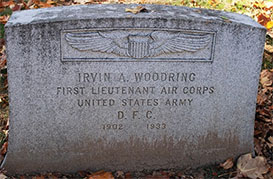
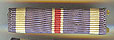
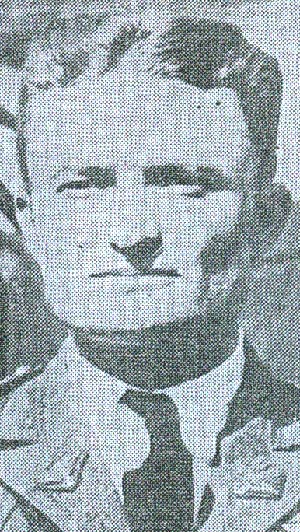
Irvin A. Woodring, ca. 1930
(Source: NASM)
 |
CURSED PILOTS; CURSED AIRPLANES
Irvin A. Woodring was one of the "Three Musketeers of Aviation" (with J.J. Williams and W.L. Cornelius), valued by the Army for their daring aerial feats.
Williams and Cornelius signed the Davis-Monthan Register, too. However, there are no dossiers for them at the NASM. Although both of them died early in aviation accidents, that's not the reason, because Woodring also died early and he has a record at the NASM.
The square-jawed Lt. I.A. Woodring landed at least three times at Tucson. Each time he flew Boeing PW-9D airplanes (28-28, 28-32 and one unidentified). He landed first on Monday June 17, 1929 at 9:00 AM. He was westbound from El Paso, TX to Rockwell Field, San Diego, CA. He must have left El Paso early, as it was about a 3-4 hour flight from there to Tucson.
A few months later he landed again on October 4, 1929 at 2:10 PM eastbound from San Diego. He returned west on Wednesday October 9th. There was no reason given for his roundtrip, although he did note in the Remarks column of the Register on October 4th simply "OK".
Regarding his aircraft, all the Boeing fighters from 28-26 to 28-41 were PW-9Ds with S/Ns ranging from 1011 to 1026. Parenthetically, Boeing 28-37 landed at Tucson on Friday July 27, 1928 flown by a different pilot. That airplane was involved in a famous midair collision with Maddux Air Lines Ford 5-AT-B NC9636 (not in the Register) at San Diego, CA on April 21, 1929, barely a year after its Tucson visit.
I.A. Woodring was born in Enid, Oklahoma February 1, 1902 and died January 20, 1933 at Wright Field, Dayton, OH. He was a hot shot pilot during his brief life. He attended Oklahoma A&M College from 1920-23 in the Department of Mechanical Engineering. He entered the Army flying school at Brooks Field, San Antonio, TX and graduated in February 1924 from the Pursuit class. Then followed three years of civilian barnstorming. In 1927 he returned to active duty and received his commission in the Regular Army and was ordered to Selfridge Field, MI with the 1st Pursuit Group.
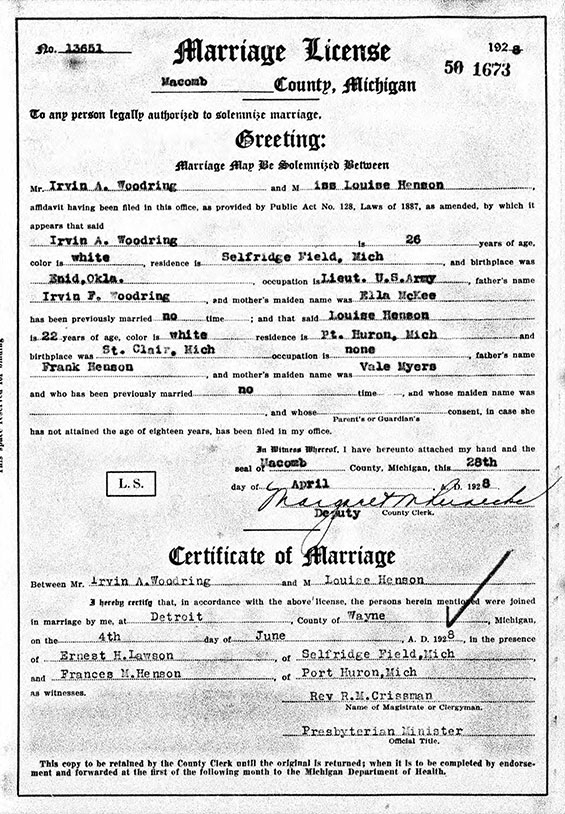
While stationed at Selfridge, he won the Mitchel Trophy Race held in Dayton, OH. He also served to escort Charles Lindbergh during part of his national tour after his trans-Atlantic flight in May 1927. On June 4, 1928, he married Louise Henson in Detroit, MI. Their marriage license and certificate of marriage are below, courtesy of ancestry.com.
I.A. Woodring/Louise Henson Certificate of Marriage, June 4, 1928 (Source: ancestry.com)
 |
Later in 1928 he transferred to Rockwell Field and became a member of "The Three Musketeers", who performed their hair-raising aerobatics at the National Air Races (NAR) at Los Angeles, CA that year (Mines Field, Sept. 8-16). Next, Woodring was a member of the refueling crew for the Army endurance airplane, the "Question Mark" during its record-breaking flight in January 1929. Along the way he picked up transport pilot license no. 1867. The 1930 U.S. Census placed Woodling (28) living in Coronado, CA with Louise (24). He was a lieutenant in the Army.
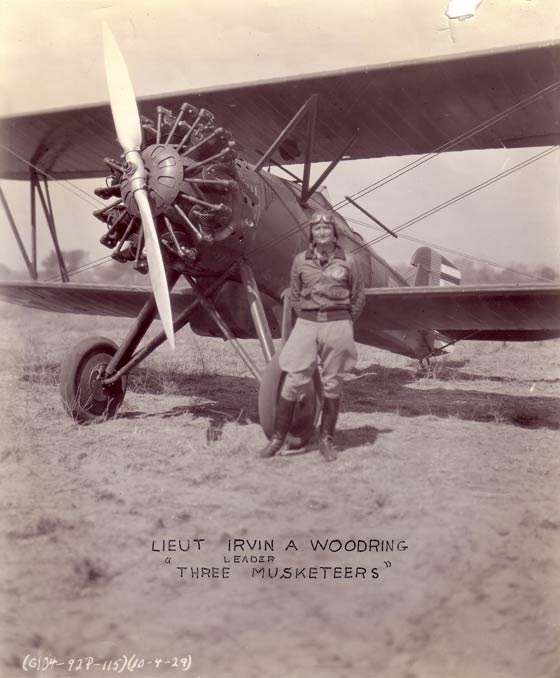
Below, shared with us by site visitor Roger Holden, is a photo of Woodring in front of a Boeing P-12. Holden says about the image, "His A-1 flying jacket bears the 'Kicking Mule' insignia of the 95th Pursuit Squadron."
I.A. Woodring, October 4, 1929 (Source: Holden)
 |
Several interesting news articles, notably one from the New York Times dated November 9, 1929, appear in Woodring's NASM dossier. They cite a high-altitude incident on November 8, 1929. He departed Rockwell Field in a supercharged Boeing P-12 with special oxygen tanks and other apparatus for high-altitude testing. He was scheduled to rendezvous with another airplane at 25,000 feet. Upon reaching that altitude he was over Tijuana, Mexico cruising at 130 MPH heading for Rockwell again. After cruising for 30 minutes he found that he had not moved from over Tijuana due to high wind velocity. I wonder if this obscure news article in his dossier is one of the first observations of the high-altitude prevailing winds that came to be known as the Jet Stream.
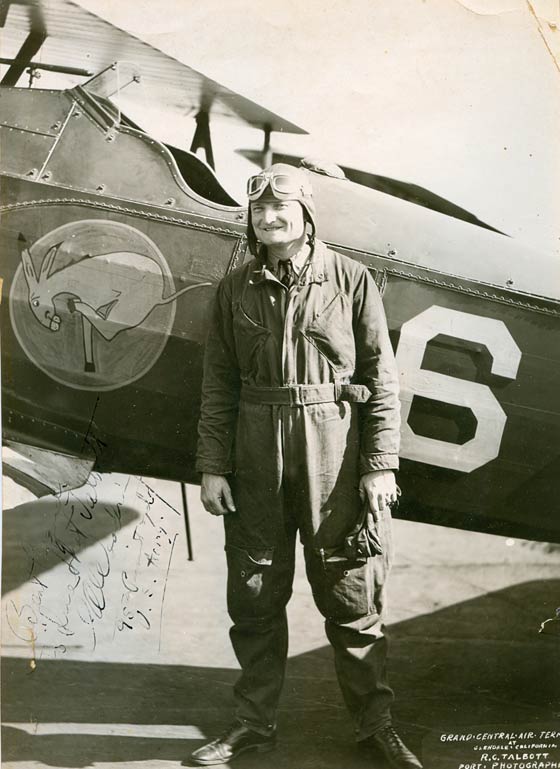
Below, from friend of dmairfield.org, John Underwood, a signed photograph of Woodring with a Boeing P-12. It is unknown if this P-12 is the one used above, or the one used in the adventure that follows these images.
I.A. Woodring and Boeing P-12, Glendale, CA, Date Unknown (Source: Underwood)
 |
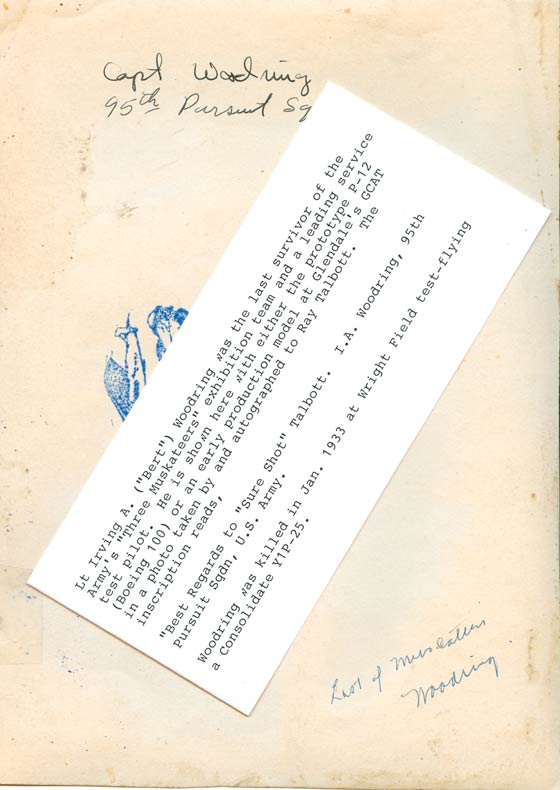
Below, the caption on the back of this photograph.
Caption: I.A. Woodring and Boeing P-12, Glendale, CA, Date Unknown (Source: Underwood)
 |
In 1930 he became a member of the Caterpillar Club when he had to take to his parachute when the airplane he was dog-fighting with broke up during Air Corps Maneuvers at Sacramento, CA. On October 15, 1930 he carried the Japanese ratification of the London Naval Treaty from Vancouver, BC to New York City. He won the Distinguished Flying Cross for his heroism during that flight.
I.A. Woodring, Ca. October 16, 1930 (Source: SDAM)
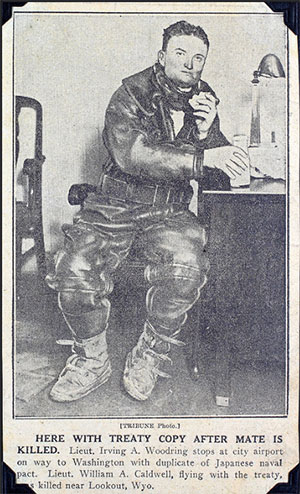 |
The undated and unsourced news article at left is courtesy of the San Diego Aerospace Museum Flickr Stream (SDAM). It cites Woodring's interim stop during his cross-country flight. He appears to be eating a sandwich and drinking a pint of milk. Note his wind burned face.
He and wingman W.W. Caldwell, flying Boeing P-12Cs, received orders to fly this document of international importance to New York for delivery by October 18th. They ran into foul weather in Wyoming but, in pursuit aircraft not fitted for instrument flight, they persisted in their task. Campbell crashed to his death. Woodring arrived at Newark at 7PM October 16th and delivered the document.
His experiences with "The Three Musketeers" received the most press in his NASM dossier. They performed, along with the analogous Navy team named "The Three Seahawks" (see Register pilot D.W. Tomlinson), at the 1928 NAR in Los Angeles. J.J. Williams was the first Musketeer to perish during an early performance at Mines while flying inverted at a very low altitude. Charles Lindbergh took Williams' place for the final five days of their NAR performances.
Cornelius was killed a couple of weeks later at Rockwell Field during regular daily formation practice maneuvers when his airplane crashed into another one while airborne. Cornelius' parachute became entangled in the descending wreckage and he went down with it. So ended "The Three Musketeers".
A little over a year later, on April 23, 1930, Woodring took to his parachute again. This time he was dog fighting with Hugh Elmendorf (signed the Register four times), performed an unusually stressful maneuver (from the newspaper description it sounds like he made a very fast load change from positive to negative Gs) that caused his aircraft to go out of control. He parachuted successfully from about 2,000 feet.
News Account of Woodring Demise, ca. January 20, 1933
(Source: NASM)
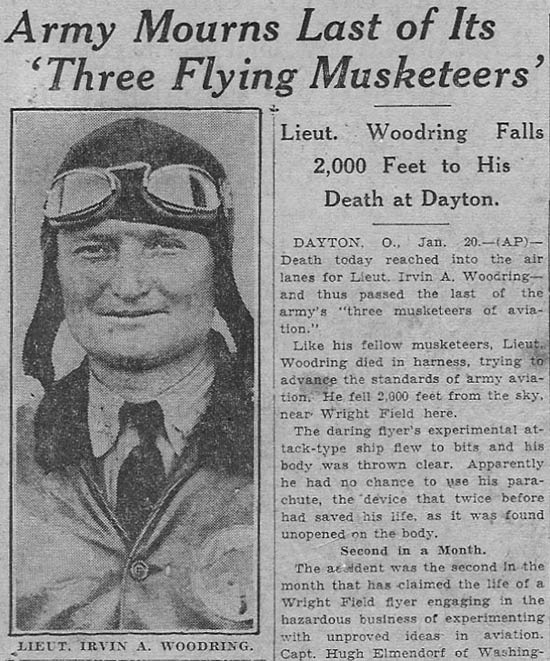 |
On Friday January 20, 1933 he was at Wright Field, Dayton, OH. The news account states, "Lieut. Woodring was killed in a mid-air explosion while testing a new airplane..." The airplane he crashed in is cited at Joe Baugher's site as the Consolidated Y1P-25, "32-322 completed as Y1A-11 attack aircraft. Crashed Jan 20, 1933, killing pilot 1st Lt. Irvin Woodring." Ancestry.com reported that he died February 20th. His grave marker from the Arlington National Cemetery is above, left
Popular Aviation, September, 1933 (Source: PA)
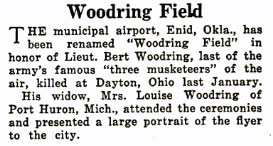 |
The article, right, from Popular Aviation (PA) magazine, September, 1933, records the re-dedication of an Oklahoma airport as "Woodring Field." Louise participated in the event.
---o0o---
Below are text and images provided by site visitor John Lyon (cited, right sidebar).
I.A. Woodring, ca. 1930
(Source: Lyon)
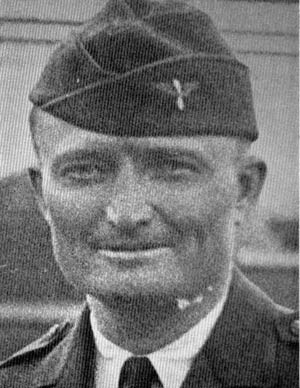 |
"Irwin A. Woodring, was a second lieutenant in the Air Reserve in 1927. In that year he went to Selfridge Field, Michigan, and there was relieved from extended active duty to accept regular appointment, being assigned to his old outfit, the 27th Squadron. (On the same day Jimmy Doolittle made the same transition, but to the 95th Squadron).
"On the third of May he was pilot of one of a flight of 19 P-1 pursuits which made a flight from Selfridge to Ft. Riley, Kansas, between 7:00 a.m.and 5:15 p.m, with a stop at Chanute Field in Illinois. Next day they went on to Fort Sill. This was a pretty good cross-country for the times. In September [1927] he placed third in the 'Free-for-All' race at the National Air Races, flying his [Curtiss] P-1-B at 153.660, about a mph out of first [the Aircraft Yearbook reports his second-place speed at 155.046 MPH; about 3 MPH slower than the winner at 158.412 MPH]. He went on to win the Mitchel Trophy Race at 158 mph [158.968 MPH; October 12, 1927].
"On June 27, 1928, he transferred to the 95th Pursuit at March Field, the same outfit as Doolittle. It bounced back and forth between March and Rockwell for some years. During this time the Nasal Radiators [sic; naval aviators] formed the first U.S. service aerial demonstration group, 'The Seahawks', which did tied-together aerobatics. Not to let the Navy get by with this kind of uppity behavior, the Army did likewise, founding the 'Three Musketeers.'
Cornelius, Lindbergh and Woodring, NAR 1928
(Source: NASM)
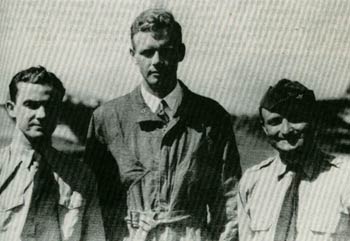 |
"The original members were Lts. Cornelius, Williams and Johnson. Johnson was killed while escorting Lindbergh on a Canadian tour, and Woodring took his place. This group gave demonstrations all over the country. Williams was killed while stunting solo in front of a huge crowd at the National Air Races in September, 1928. Lindbergh substituted for him for the remainder of the Races...."
Lindbergh appears at center in the photo at right, probably taken shortly after Williams' crash.
With Cornelius' and Williams' deaths, the "Three Musketeers" ended as a performance group. With Woodring's passing, all three members had perished inside of five years. The airport at Enid, OK is named the Enid Woodring Municipal Airport on May 30, 1933. Woodring also held a civilian pilot certificate. He flew with Transport pilot certificate, T1867.
Woodring (R), Enid, OK, Ca. 1905 (Source: Kanase)
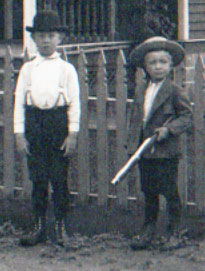 |
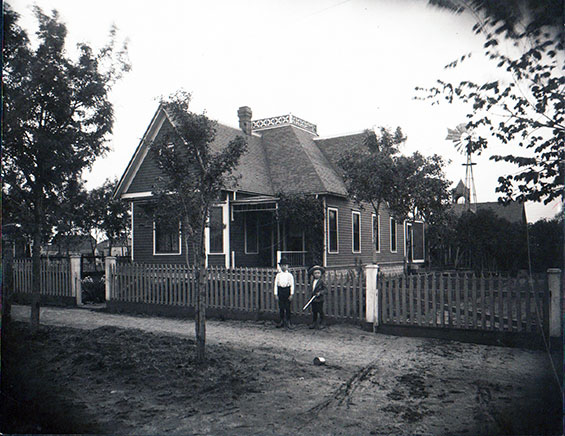
UPDATE OF October 4, 2016. Site visitor L. Kanase shares with us the six photographs below that were found in a thrift shop. The small photograph, right, was cropped from the larger image, below, that captured Woodring and "James" (a brother?) outside their home in Enid, OK. The caption written on the back of the photo dates it as sometime in 1905. If the date was 1905, Woodring would have been about three years old. He looks a little older, so the date on the back of the photo might have been in error. Regardless, Woodring holds a toy rifle and wears leggings and a flat-brimmed hat. James poses in a derby, boots and gallaces. I brightened the image in PhotoShop.
Below is the wider photograph of the Woodring home in Enid, OK, ca. 1905. In another view, the house appeared to be just down the street from a church. You can see the steeple of the church in the background, behind the windmill. I brightened this image in PhotoShop. Note the hoof prints and surrey tracks leading in and out of the gate.
Woodring Home, Enid, OK, Ca. 1905 (Source: Kanase)
 |
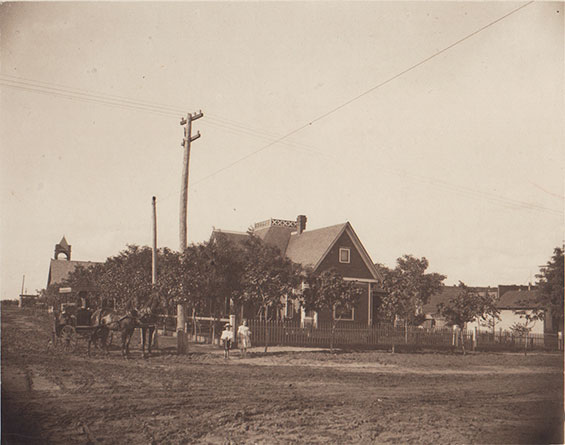
Below, another view of the Woodring home, this time with the family horses and surrey (fringe on top) on the road. Woodring stands with his toy gun butt resting on the toe of his boot. The photo above was probably taken at a different time, because, below, Woodring was not wearing leggings or a jacket. He stands next to an unidentifed young woman, probably his older sister, Ruby (1892-1909). Note the power poles.
Woodring Home, Enid, OK, Ca. 1905 (Source: Kanase)
 |
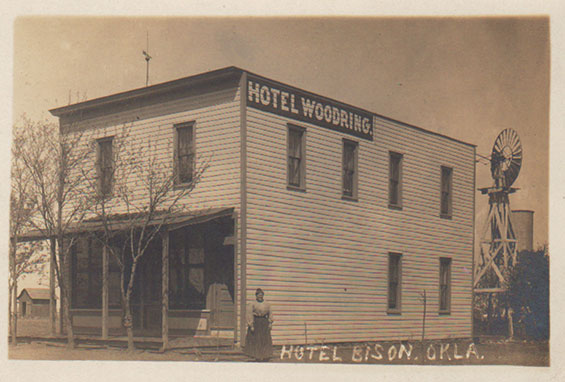
The 1910 U.S. Census, his first, placed Woodring (age 8) living with his mother, Sarah E. (49) and father, Irvin F. (55) in Sumner Township, OK. His sister had been deceased for a year. Woodring's father cited his occupation as a "Trader" in "Buggy (?) & Seed." His mother was a "Manager" of a "Hotel." The family hotel in Bison, OK is shown below on a picture postcard that was among the photographs. The woman was unidentified, but could be Woodling's mother, Sarah. Bison, OK is about 14 miles due south of Enid.
Hotel Woodring, Bison, OK (Source: Kanase)
 |
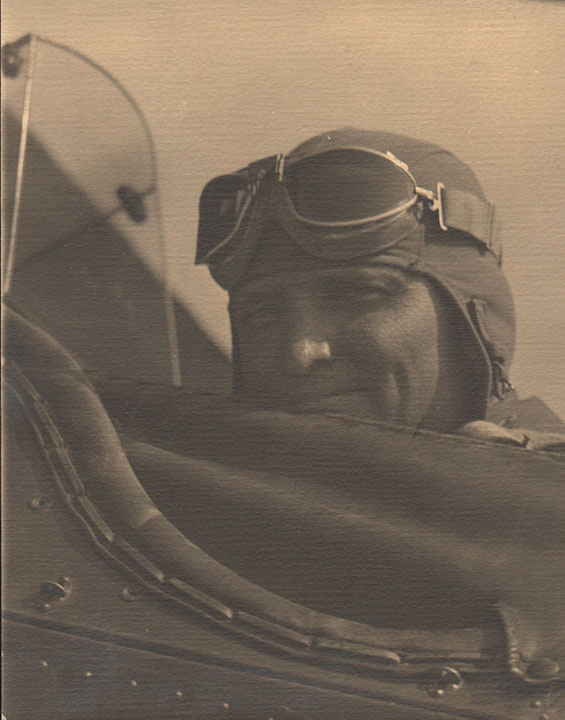
Below, Woodring appears in the cockpit of an unidentified aircraft, date and location unknown. Note the robustly laced leather coaming, and what appears to be a leather wind screen erected at shoulder level and snapped in place.
Woodring in Cockpit, Date & Location Unidentified (Source: Kanase)
 |
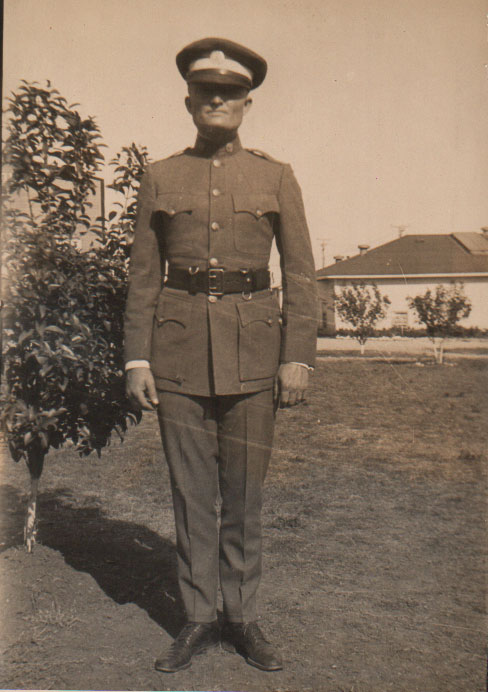
Below, a full-length portrait of Woodling in uniform.
E.A. Woodring in Uniform, Date Unknown (Source: Kanase)
 |
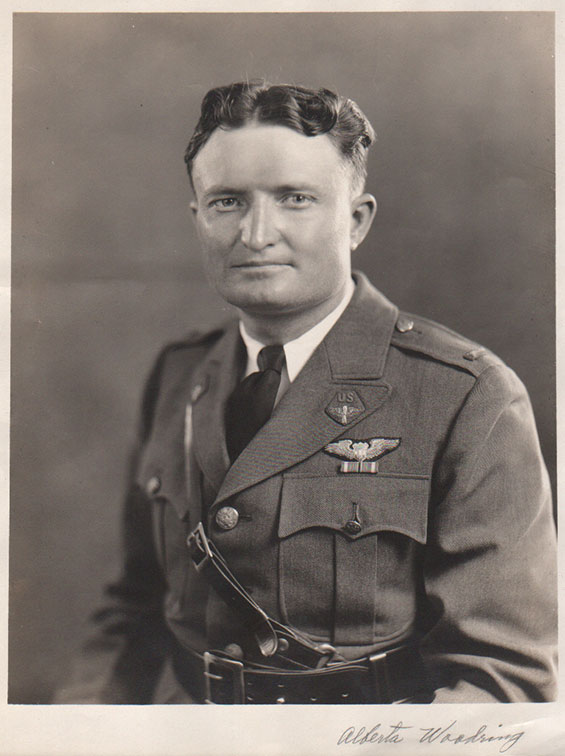
Finally, below, a formal portrait of Woodring in uniform, date unknown, but the back of the photograph is annotated, "WWI Ace." The ribbon under his wings appears to be for the Distinguished Flying Cross, 3rd Pursuit Group, left. If anyone can corroborate this identification, please let me KNOW.
I.A. Woodring in Uniform, Date Unknown (Source: Kanase)
 |
His friends called him "Bert."
---o0o---
Dossier 2.2.189
THIS PAGE UPLOADED: 01/29/08 REVISED: 04/04/08, 03/15/10, 05/12/10, 07/13/12, 11/28/13, 01/07/15, 10/04/16
|