|
Biographies are but the clothes and buttons of the man—the
biography of the man himself cannot be written.
—Mark Twain
Pilot George Brett was born in Cleveland, OH February 7, 1886.
George Brett, VMI Graduate, 1909
(Source: Brett Family)
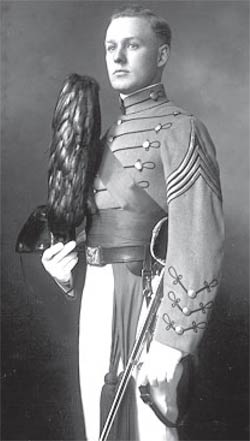 |
Brett did not finish high school, yet he completed studies at the Virginia Military Institute in three years and graduated as number two in his class in 1909. He was appointed a 2nd lieutenant of the Philippine Scouts on March 22, 1910, serving in the Philippines for a year and a half. At right is his VMI graduation portrait. Interestingly, The Philippines was his second choice. His first choice, Coastal Artillery, was closed to him, because he failed to pass the physical examination: he was color blind.
In October 1915 he attended aviation school until August of the following year, when he graduated (one of five to receive wings, and, because he soloed and aircraft before December 17, 1916, he became a member of the Early Birds). He was assigned to Washington, DC, in the office of the Chief Signal Officer. He was promoted to first lieutenant in 1916 and to captain in 1917. He attached a woman to his rising star when he married Mary Devol in Denver, CO on March 1, 1916.
In November 1917 he left the United States bound for aerial combat in World War I. This was not to be, because he suffered an attack of appendicitis. The appendectomy was a dangerous operation in 1917. In those days surgeons cut from navel to backbone. He was forced to spend much of his time recovering, and he was removed from flying status.
After convalescence, he was assigned as Billy Mitchell’s senior materiel officer and he eventually became one of his supporters. He spent a lot of time in England and Washington, DC.
After WWI, Brett made his way to Kelly Field, Texas, in December 1918. He commanded the aviation general supply depot until February 1919, when he became the maintenance and supply officer at the Air Service Flying School.
Intimations began to appear regarding the "difficulty" he would have in maintaining his rising star momentum. Brett’s evaluation record shows a problem with disciplining himself to salute smartly when a commander made a decision. In the summer of 1918 he was rated “very good,” but that he was “somewhat given to forcing his own opinions.”
In a later appraisal Brett received a rebuke from Col. C.G. Edgar of the Air Service. In the summer of 1919 Edgar evaluated Brett’s service at Kelly Field in the following words:
"This officer is not physically fit for service in the U.S. Army under War conditions either in the field or bureau work. During a visit to Washington on official business, while he was on duty with the Air Service in England, Major Brett was in my opinion head-strong and difficult to handle. His desires seemed to be more in securing leave of absence than to be helpful to the Washington office and the winning of the War....Personally Major Brett is a very attractive and polished gentleman."
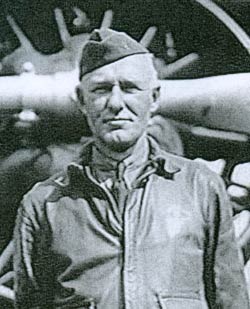
George H. Brett, With the 1st Pursuit Group, National Air Races, Cleveland, OH, ca. August-Sept, 1931
(Source: NASM Biographical File)
 |
Regardless, he was appointed as Commander of Crissey Field, San Francisco, CA in 1921 (which he assumed from H.H. Arnold). In 1927 he moved to Fairfield, OH, and then in 1928 to the Air Corps Tactical School at Langley Field, VA.
He then took command of the 1st Pursuit Group at Selfridge Field, Detroit, MI from 1930-1933. According to sources, this was one of his favorite assignments. One of his subordinates there was an officer named Curtis LeMay. Fellow Register pilot Victor Strahm was also with him at Selfridge. At left we see him posed with one of the Group's airplanes at the 1931 National Air Races in Cleveland, OH.
He was then appointed as an instructor at the Command and General Staff School at Fort Leavenworth, KS, and was assigned the rank of Lt. Colonel in 1934.
He attended the Army War College in 1935, was appointed (temporarily) Brigadier General and assigned as Commander of the Composite Wing at Albrook Field in the Canal Zone. At the end of his Panama assignment in 1938, world war was near, and it was the last of his peacetime jobs. There is no indication of whether he either changed or improved his salutes.
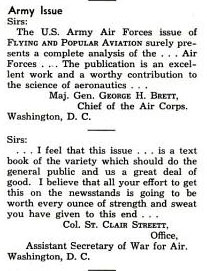
Flying & Popular Aviation Magazine, October, 1941 (Source: PA)
 |
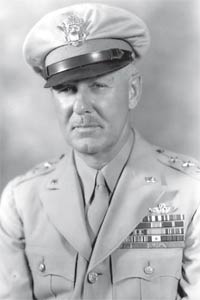
Lt. Gen. George Brett, Caribbean Duty (Source: Brett Family)
 |
He returned to the United States and went through a succession of demanding and rapid assignments with his appointment as Major General in October 1940. In May 1941 he was selected as the Chief of the Air Corps, which involved him in the procurement and maintenance of aircraft and equipment, and the training of personnel for the rapidly expanding Army Air Corps.
He wrote an article about this new job in the September, 1941 issue of the magazine Flying and Popular Aviation (PA). This issue was a 200-page tome describing the organization of the Army Air Corps. Other generals contributed articles in their fields of expertise. And the first chapter of the Arnold/Eaker book, "Winged Warfare," was also included. At left is a pair of letters that appeared in the letters column of the October, 1941 issue. Both Brett and fellow Register pilot Streett took time to praise the issue. Parenthetically, why the content of the magazine wasn't considered confidential information, is a mystery,, given the almost sure involvement of the U.S. in the conflict on the cusp of WWII. A complete review of naval aviation was the subject of the January, 1942 issue! It included photographs of every kind of naval aircraft (including identification silhouettes), as well as aerial and profile views of all its carriers, including the brand new Hornet. It was a goldmine for enemy agents.
Curiously, Brett's article was interpreted by some as critical of the position. This led his immediate commander, General Arnold, to evaluate his performance as only "excellent" rather than "superior", stating, “His personal views at times govern his course of action rather than willing and generous support to the plans of his superiors.”
During WWII he moved from Britain to Egypt to the south western Pacific to China, Burma, Java, Australia (where he was Commander of Allied Air Forces) and the Caribbean. His intereactions with McArthur in Australia were tense. This led to his relief by MacArthur and relegation to the Caribbean area.
But, in the Pacific he saw action in the famed B-17 named "Swoose" (now at the NASM Paul E. Garber Preservation, Restoration, and Storage Facility at Silver Hill, Maryland, but soon to be turned over to the Air Force Museum at Wright Patterson AFB in Dayton, OH), which he flew more than 150 hours per month across Australia and into the combat zone around Port Moresby. He held honorary commissions from five Central and South American countries. He received the Distinguished Service Medal, Distinguished Flying Cross, Silver Star, Order of Bath, and Order of Oranje. Nothing was ever said about his color vision, or lack thereof.
He retired from the military in 1945 as a Lt. General, after 35 years of service. He continued to keep his hand in aviation by serving on several committees and Air Force boards, including the President's Service Academy Board in 1949 and 1950.
Isn't it funny how sometimes you don't get credit for walking on water, because somebody criticizes you for having the bottoms of your feet wet?
George Brett died at age 77 December 2, 1963 in Orlando, FL. He is buried at Winter Park, FL.
---o0o---
George Brett landed and signed the Davis-Monthan Register three times. His first landing was on Saturday January 23, 1926 at 2:30 PM. He was flying a Douglas O-2B, 25-384. Based at Dayton, OH Wright Field he was eastbound from San Diego, CA Rockwell Field to El Paso, TX. He carried as passenger a Capt. Ocker (quite possibly Register pilot William C. Ocker).
His second landing was on Wednesday, March 18, 1931 12:00 PM. He was solo in Boeing P-12-D (or C), 31-224. We know a lot about the context of this flight, because his grandson, George H. Brett, II, has shared with us the following information from his grandfather's pilot log book.
George Brett's Pilot Log Book, March 3-21, 1931
(Source: Brett Family)
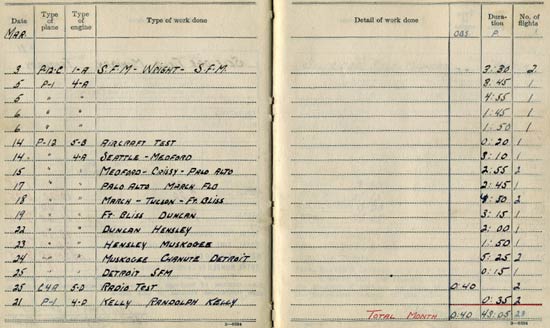 |
We have, above, pilot Brett's log entries for his flights with 31-224 that brought him to Tucson on March 18th. His Boeing P-12-D (although this link describes the airplane as a P-12-C) was delivered on March 14 from the factory in Seattle. He tested it for 20 minutes before departing for Medford, OR on his way to Selfridge Field, Detroit, MI. The only confusing item is the "Type of Engine" designation. Was there a quick engine change from a "5-B" to a "4-A", or did Brett make an entry error? If anyone can interpret this, please let me KNOW.
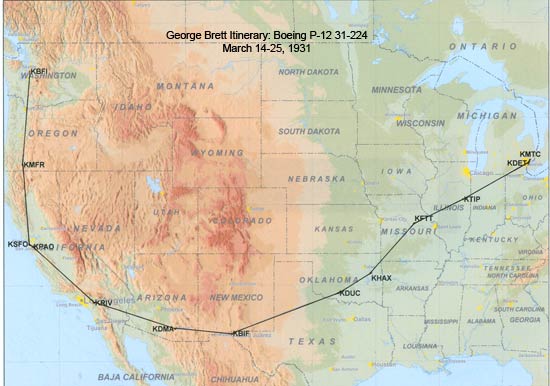
George Brett's Tucson Itinerary, March 14-25, 1931
(Source: Webmaster)
 |
Regardless of the engine, from the context of the Register, on March 18th, when he landed at Tucson he was traveling with a group of at least four other pilots based at Selfridge Field, Detroit, MI that landed on the 17th and 18th in P-12-Ds. Among his fellow officers was Victor Strahm, N.B. Harbold, Harry A. Johnson and S.P. Wright.
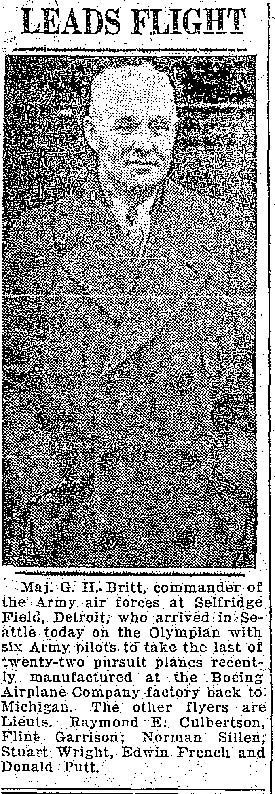
Seattle Times, February 8, 1932 (Source: Woodling)
 |
Above is a chart of their itinerary derived from Brett's pilot log. They departed Saturday March 14th and arrived at Detroit Wednesday the 25th. They flew for 26 hours and 24 minutes distributed across 12 individual flight legs. This is a 2,819 mile voyage that took them about ten days to complete.
More broadly, this movement of Boeing aircraft from the manufacturer in Seattle to Selfridge Field near Detroit was probably part of the transition by Brett's 1st Pursuit Group from Curtiss Hawks to Boeing airplanes. For contrast, here is an example of the Curtiss Hawk, and here is an image of Brett flying the newer Boeing.
In the chart above I have superimposed on the route a topographic representation of terrain. This is an excellent example of why so many pilots chose to use Tucson as a stopping point during their travels east and west, and why the Register of the old Davis-Monthan Airfield is such a rich repository of Golden Age flight activity. Specifically, Tucson lies on the relatively low-altitude airway between the west coast, Texas and points east. Just a few miles north and the terrain (darker brown) approaches, and in many cases exceeds, the altitude limits for the pilots and aircraft of the era.
Brett's third and final visit to Tucson was logged in the Register sometime between February 10 and 18, 1932 (he didn't record the date). He was again with a group of six other Selfridge-based pilots all flying unidentified Boeing P-12-Ds. Besides not recording the numbers of their airplanes, they did not list an origin or destination for this flight. Brett's pilot log for this date is equally uninformative, including just a total of flight hours for the month, with no mention of how, where, or in what aircraft, the hours were accumulated.
From his Register record, however, it is safe to guess that this was another ferry flight of new aircraft from the Boeing plant to Selfridge. This guess is corroborated by the article appearing in the Seattle Times of February 8, 1932 shown at left. If you examine page 182 of the Register, you'll see listed Brett and the other pilots named in the article. Their homebound route, in turn, was similar to the one illustrated in the chart above (see the next article, below).
Further documentation of this particular flight is found in a two-page article in the Air Corps Newsletter for Jan-Jun 1932 (I spliced the pages together with PhotoShop). The article is exhibited in its entirety below and it is an interesting and insightful read. The Newsletter was an "officially informal" synopsis of significant activities happening across the U.S. at the various Army Air Corps installations. This article very nicely describes the preparations, execution and itinerary of the ferry flight of new Boeing aircraft from Washington to Selfridge Field as documented following Brett's name at the bottom of Register page 182.
While documenting the trip, this article is also amusingly tongue-in-cheek about the activities of the pilots. They were, after all, mostly young men with the egos of pursuit pilots, who took every opportunity to explore fun. These opportunities included taking full advantage of a two-day weather delay to explore the city of San Francisco, excursions (twice) to "the nearest foreign country," Mexico in this case, and a chicken dinner at the home of one of the pilots as they passed through Texas.
Air Corps Newsletter, February, 1932 (Source: Web)
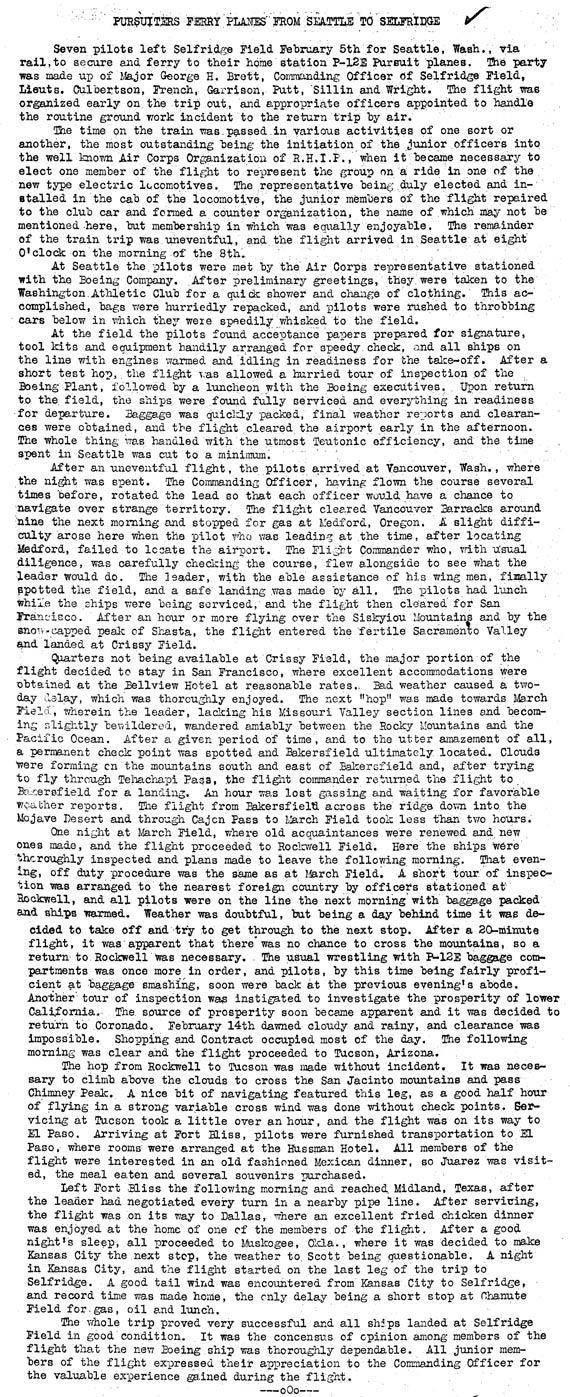 |
Their stop at Tucson was documented at the end of the 7th paragraph. Although not cited in the Register, calculating from the stops documented in the Newsletter leaves us with a date of February 13 or 14 for their arrival at Tucson. They did not remain overnight, instead continuing to El Paso, TX where their second visit to Mexico was made. The rest of their journey was made in fair weather with tail winds.
We seldom find this type of documentation that refines the reasons and confirms the people and timing of a flight through Tucson. The Air Corps Newsletter is a good example, presented in a highly readable fashion.
---o0o---
Dossier 2.2.36
UPLOADED: 02/07/08 (Happy 122nd Birthday, George) REVISED: 02/08/08, 02/10/08, 12/21/09, 12/05/12, 07/15/14
|



